Baking Dish Size
Recipe calls for a 9 × 13 but you only have round cake pans? Pick the pan the recipe uses and the one you have, and the converter compares their area and volume, tells you how much to scale the recipe, and gives baking time tips. The chart lists the capacity of common baking dishes, from loaf tins to half-sheet pans.
- Free to use
- No sign-up
- Runs in your browser
Baking pan converter
Or enter a custom pan (inches): × ×
Baking Pan Conversion Pack
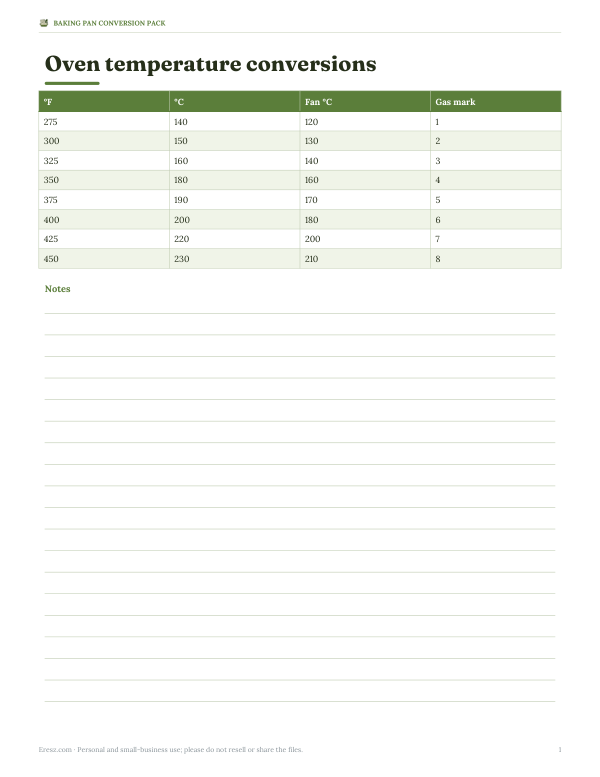
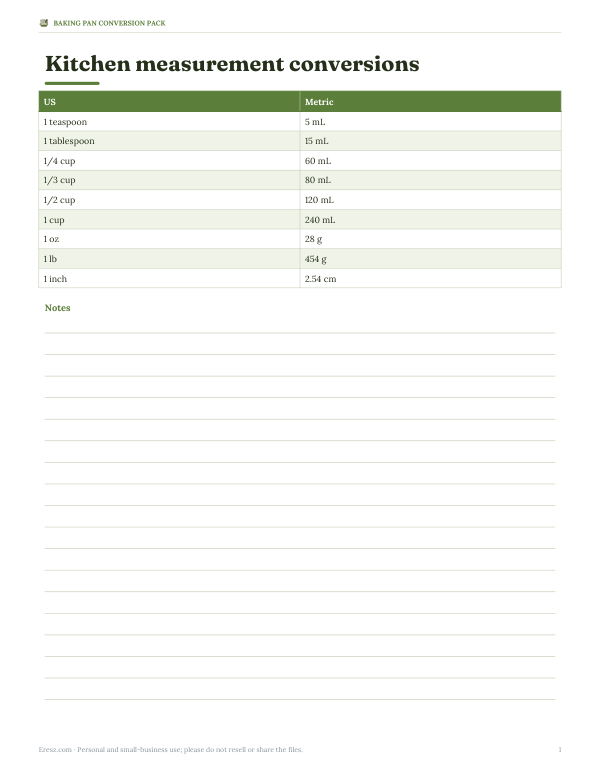
Printable baking pan size and volume chart, a pan substitution guide, oven temperature conversions and a kitchen measurement conversion card, plus an Excel recipe scaler.
- Pan chart (PDF/XLSX)
- Oven temps (PDF)
- Measurement card (PDF)
- Recipe scaler (XLSX)
Formats: PDF, XLSX. Instant download after payment (link valid 72 hours, up to 5 downloads). AI-assisted: the templates were drafted with AI help and reviewed and laid out before publishing.
$3.00 USD, one-time 4 files · about $0.75 each
- Instant download
- 7-day refund
- Secure checkout by Stripe
7-day money-back guarantee. Full refund within 7 days of purchase, even after you download.
Free sample: Baking Pan Size Chart (PDF, 71 KB)
Full refund within 7 days — see the refund policy and license.
Free printables
Single sheets you can print right now, no sign-up. The full pack adds every sheet in one download plus the editable files.
 Printable Recipe Scaler Sheet
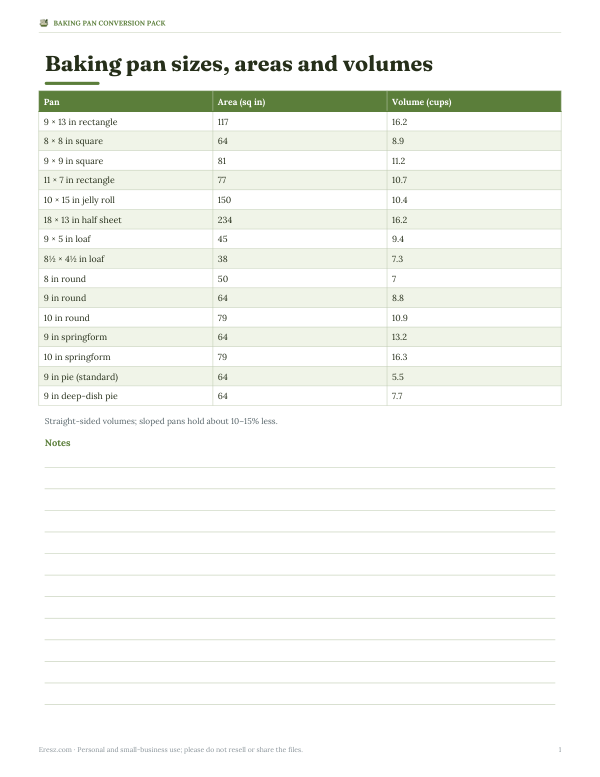
Common baking dish sizes
| Pan | Area (sq in) | Approx. volume (cups, straight sides) |
|---|---|---|
| 9 × 13 in rectangle | 117 | 16.2 |
| 8 × 8 in square | 64 | 8.9 |
| 9 × 9 in square | 81 | 11.2 |
| 11 × 7 in rectangle | 77 | 10.7 |
| 10 × 15 in jelly roll | 150 | 10.4 |
| 18 × 13 in half sheet | 234 | 16.2 |
| 9 × 5 in loaf | 45 | 9.4 |
| 8½ × 4½ in loaf | 38 | 7.3 |
| 8 in round | 50 | 7.0 |
| 9 in round | 64 | 8.8 |
| 10 in round | 79 | 10.9 |
| 9 in springform | 64 | 13.2 |
| 10 in springform | 79 | 16.3 |
| 9 in pie (standard) | 64 | 5.5 |
| 9 in deep-dish pie | 64 | 7.7 |
Real pans with sloped sides and rounded corners hold a little less than these geometric volumes — a typical 9 × 13 × 2 pan holds about 14–15 cups rather than 16. To check your own pan, fill it with water one cup at a time.
Converting a recipe between pans
The key is area. Batter spread over a larger area bakes thinner and faster; over a smaller area, deeper and slower. Divide the area of your pan by the area of the recipe’s pan to get the scale factor, then multiply every ingredient by it. A 9 × 13 pan (117 sq in) holds almost exactly the batter for two 9-inch rounds (2 × 63.6 = 127 sq in), which is why so many layer cake and sheet cake recipes are interchangeable.
Handy equivalents
| Recipe pan | Works in |
|---|---|
| 9 × 13 in | Two 9 in rounds · two 8 × 8 in squares (slightly thinner) · 24 cupcakes |
| 8 × 8 in | One 9 in round · 12 cupcakes |
| 9 × 9 in | 11 × 7 in rectangle · one 10 in round (thinner) |
| 9 × 5 in loaf | 8 × 8 in square · 12 muffins |
| Two 8 in rounds | One 9 × 9 in square (thicker) · 24 cupcakes |
| 10 in bundt (12 cups) | 9 × 13 in · two 9 × 5 in loaves |
These are approximate; the converter gives exact area ratios.
Adjusting baking time and temperature
- Shallower batter (bigger pan, same amount) bakes faster — start checking 5–10 minutes early.
- Deeper batter (smaller pan) takes longer; lower the oven by about 25°F (15°C) so edges don’t overbake while the centre cooks.
- Glass and ceramic dishes hold heat; many bakers reduce the temperature by 25°F compared with metal pans.
- Dark metal pans brown faster than light ones.
- Test doneness with a skewer or by pressing lightly — times in recipes are guides.
Worked example
A sheet cake recipe uses one 9 × 13 in pan (117 sq in). You want two 9-inch round layers (127 sq in in total). The converter shows a scale factor of about ×1.09 — close enough to use the recipe as written with slightly thinner layers, or scale up by 10% for the same depth. For two 8-inch rounds (101 sq in), the factor is ×0.86, so the layers will be a little thicker unless you remove a few spoonfuls of batter for cupcakes.
Casseroles and lasagne
Savoury dishes follow the same rule. A lasagne for a 9 × 13 dish can be split between two 8 × 8 dishes (128 sq in) — one to eat and one to freeze. Baked pasta and casseroles are forgiving: similar depth matters more than exact volume, and cover the dish with foil if the top browns before the centre is hot.
Cupcakes, muffins and mini pans
A standard muffin cup holds about ½ cup of batter to the brim, and is usually filled two-thirds full, so a recipe for a 9 × 13 cake (around 6–7 cups of batter) makes roughly 24 cupcakes. Mini muffin cups hold about 2 tablespoons. Cupcakes bake much faster than a cake — typically 18–22 minutes at the same temperature — so check early. Jumbo muffin cups hold about 1 cup and need 25–30 minutes.
Metric pans
Many European pans are sold in centimetres: a 20 cm square is close to an 8-inch square, a 23 cm round to a 9-inch round, and a 20 × 30 cm tray bake tin to an 8 × 12 inch pan. To use the converter, divide centimetres by 2.54 and enter the result as a custom pan.
Measuring a pan
- Measure across the top, from inside edge to inside edge — not the outside or bottom.
- Measure the depth vertically from the bottom to the rim.
- For round pans, measure the diameter across the top.
- Check the bottom of the pan: many manufacturers stamp the size there.
Privacy
The converter runs in your browser and stores nothing.
Frequently asked questions
How many cups does a 9 × 13 pan hold?
About 14–15 cups to the brim with typical sloped sides.
Can I use two 9-inch rounds instead of a 9 × 13?
Yes, their combined area is very close.
How do I convert a recipe to a different pan?
Divide your pan’s area by the recipe pan’s area and multiply all ingredients by that factor.
Do I need to change the baking time?
Yes, if the batter depth changes: shallower bakes faster, deeper slower.
How do I measure a baking dish?
Across the top from inside edge to inside edge, plus the depth.
Is an 8 × 8 pan the same as a 9-inch round?
Nearly: 64 sq in versus about 64 sq in, so recipes swap easily.
Can I bake a cake in a glass dish?
Yes; many bakers lower the oven by 25°F and check early, because glass holds heat.
Is my data stored?
No, it runs in your browser.